The following are the stages which I have undertaken so far:
Picking the Artwork
Researching the Technique of the Artist, stories surrouning the painting, the artist himself
Sketching
Staging and photographing Model 1 (Noha El Khatib as Mary Magdalene)
Studying Lighting in image (photographer consultation)
Photoshopping - Model Picture
Diorama construction
Painting Sketch of Diorama
Photoshoping - Diorama pictures
STAGES REMANING UNTIL DEADLINE (May 2nd)
Staging and photographing Model 2 (Aya Atwieh as Martha)
Photoshopping - Model 2 picture
Placing Noha and Aya together through photoshop
Combining diorama table, Models, Objects into final photograph with Photoshop
Using photoshop image, adjusting dimensions so that they are easily translated into a canvas in the ratio 3:4
Gridding the image onto canvas
Painting
Monday, April 23, 2007

Sunday, April 22, 2007
Diorama diorama night and day diorama
Our Tableaux began its transition to vivant with the process of diorama construction.
From the onset, I knew I would construct the scene from paper. I had just learnt a technique from Mr. Marcelo that I felt could be translated succesfully into 3D format.
Human figures could be broken down into generalized shapes, ovals and circles. I thought by recreating that form I could sketch the diorama eventually with relative ease. This is how the process unfolded:
1. Using paper strips, I recreated the models and mimicked body positions (as well as the little flower of which I'm quite proud)
2. I cut a base out of styrafoam to represent the floor (not seen in orginal piece), then shaved the edges with a sanding machine (whoever hasnt tried carving styrafoam should attemp it at least once) to clean it up, the attached a thin foam board (white) to the back to act as the wall.
3. I placed the paper ladies on it after "clothing" them with tissue paper to replicate the fabric.
4. I nailed 2 pieces of wood together to serve as the table top
5. Using a metal wire of medium thickness, I created the outline of the mirror that Mary rests her hand on
6. Painting the diorama. The background was initially white, as was the floor. I used the moody earth tones that Caravaggio employed to add artistic relevance to the 3D miniature model.
7. Photographing the Maquette
The importance of this step shed light on the purpose of the dioarama. I did not intitally understand the function, but after framing the scene the whole image came to light. I took the picture at different exposures in order to explore variations to the background, perhaps making it more appealing for modern day audiances.
a. diodrama - low exposure

b. table dimensions in focus

This table photo catalysed the most important observation I had made throughout the construction. My prespective and sketches of the diorama pre photograph had been skewed. Now, after adding the framework to the construct I am able to see how the models will interact with the object in the room.
c. exagerrated hues

This photograph is out of focus but the colors in at are appealing and interesting to look at.
I am unsure what elements the final selection will contain, but at least im self assured with an accurate prespective thanks to the Diorama.
(yes, brilliant idea, we get it Sir!)
Saturday, April 14, 2007
An obscura observation
Location: AUD Mac Lab
Interviewer: Insistent blogger (N)
Interviewee: Almoutasim Al-Maskery, Photographer (A)
N: Looking at this picture, what can you say about it?

A: Is it a painting?
N: Yeah
A: Very accurate in it.
N: What can you say about the "Camera Obscura" method alledgedly employed? He set up a box with a lens in it....whats that about?
A: A light going through a small hole then getting...flipped. Its like a pinhole.
N: What about the lens?
A: We actually see things upside down. Through the hole, thats the way the we could see things when it reflects on a wall like in those days. But with a lens, it fixes the image so we see it the "right" way up.
N: Oooh, thats so cool!
N: So what about his method? Why is his use of lighting intelligent? More recognized than other artists..
A: His lights give an accurate shadow. But you don't usually see the light shadow around the face. Its usually darker than in the painting.
N: Where?
A: Around the neck, they would be black. So his skill was in making the details in the shadow show. Let me demonstrate something to u....
Try this: Al grabs a newspaper and makes a tiny pinhole in it. A window with blinds on it is behind him, with light shining through. On a desk, infront of the window, he holds the pinholed newspaper closely to a white piece of paper.
I observe on the white piece of paper...the shadow of the blinds reflecting on the blank paper on a small scale.
It looks beautiful.
N: DUDE!
A: (Laughing)
N: So he would use the lens to flip the images...
A: The image you saw was distorted, the lens flipside upside down, yes.
N: What can you say about the "light source"...was it real or imaginary?
A: It was kept in, emphasizing probably, that lights coming from a window. Theres a dilema here. Its probably coming from a window hitting the subject but its probably from a different room - from a pinhole. Light from the window, hitting the subject, reflected on the pinhole he's drawing from.
The other alternative, [that the light] is not there so he imagined it. He created a lightsource in his head coming from an imaginary window located high up above [Mary's] face. The reflection you see in the mirror, the top right corner.
N: Freaking wow. But how could all the subjects be lit the same way?
A: Its not very accurate. The lightsource from the top should be hitting her (martha) more intensely on the head...
N: Both head
A: No only the one.
N: Any final words?
A: Its amazing how humans could use light with advantages to make like easier for them to reach their visual goals.
N: :)
After this interview, I realised the importance of taking at least one photography class if not minoring in it in some way. As an artist, one of the biggest obstacles for me when depicting reality is understanding how shadows fall on people or objects.
It may be scientific, but learning the fundamentals of it - something Caravaggion clearly mastered, would allow me to manipulate and exaggerate the shading.
Much like how our ancient ancestors accentuated the bust and female body parts to depict fertility - Caravaggio exagerrated shadows to depict drama.
Rennonsense!!!
Although my best friend in drapery might be appealing to some, its not exactly the effect i was aiming for.
I want high luxury. I want her oozing sensuality and innocence....dicotomy and allure

What? What the hell have i done?
Ok. Photoshop attempt one.
Verdict: EUW.
That...looks...like she's going to Bollywood. And she might not even get a part in a B movie.
I'm so sorry Noha. Forgive me.
I thought I'd try something else. Just to see if i could completely transport noha back in time....to this specific point

Et voila...

Not sure how i will use this, but the process of superimosing the outfit made me observe a lot of details i would have probably not picked up on. I was forced to examine shadows and reflections minus my flightly attention span....that I'm sure...will come in handy.
Diophrama coming shortly....
In stores now! A canvas slightly smaller than the original painting...!
In the year 1598...
Caravaggio woke up from sleep, probably cranky given his emotional instability.
Inspite of himself he had work to do. A painting was fermenting in his system ready to be actualized. Whether the cardinal had requested or if it was from his own imagination - the setting for the conversion of Mary Magdelene was about to unfold on a canvas.
It was said that Caravaggio set the environment and asked his models to come in separatey. Allegedly, he would sketch whoever was involved altogether - then have them come in at separate times at their (and his) conveniece.
409 years later, in a building on shiekh zayed road - an "artist" formally known as Natalie is bringing in a model to recreate the expression captured so vividly by a man who added dramatic moody lighting to the face of Baroque art.
This is how the session progressed before the final facial selection was perfectly snapped....
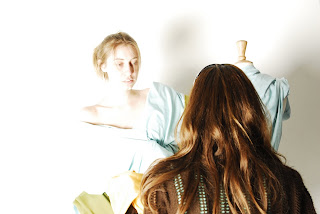
1. Setting up
The drapes were, um, borrowed from Painting class. I hope Ms. Townsend doesn't have this address...

2. Nervous model, giggling away the awkwardness.
(not seen in picture, very lucky photographer who was in the presence of much asthetic beauty)

3. Coustesy of the photographer, lighting and mood was bieng set up according to the painting. I had a printout on hand, shoving it to his face - he didn't need much coaching on my part. One look and he knew what i was going for.

4. Discussing the scene
Natalie: Ok. Here's the deal. Your a prostitute...
Noha: *blink blink*
Natalie: But you've found the "light". Your sister...has convinced you that those days are over and in one second, your life changes. We want to see the look on your face in that second
Noha: Dude. Ok. Hold on *deep breath*.....
And there we have it

5. Mary Magdelene, April 2007
Model: Noha El Khatib , best friend at large
Photographer: Al. Alfred. Altussem.
Thank you both very very much.
Inspite of himself he had work to do. A painting was fermenting in his system ready to be actualized. Whether the cardinal had requested or if it was from his own imagination - the setting for the conversion of Mary Magdelene was about to unfold on a canvas.
It was said that Caravaggio set the environment and asked his models to come in separatey. Allegedly, he would sketch whoever was involved altogether - then have them come in at separate times at their (and his) conveniece.
409 years later, in a building on shiekh zayed road - an "artist" formally known as Natalie is bringing in a model to recreate the expression captured so vividly by a man who added dramatic moody lighting to the face of Baroque art.
This is how the session progressed before the final facial selection was perfectly snapped....

1. Setting up
The drapes were, um, borrowed from Painting class. I hope Ms. Townsend doesn't have this address...

2. Nervous model, giggling away the awkwardness.
(not seen in picture, very lucky photographer who was in the presence of much asthetic beauty)

3. Coustesy of the photographer, lighting and mood was bieng set up according to the painting. I had a printout on hand, shoving it to his face - he didn't need much coaching on my part. One look and he knew what i was going for.

4. Discussing the scene
Natalie: Ok. Here's the deal. Your a prostitute...
Noha: *blink blink*
Natalie: But you've found the "light". Your sister...has convinced you that those days are over and in one second, your life changes. We want to see the look on your face in that second
Noha: Dude. Ok. Hold on *deep breath*.....
And there we have it

5. Mary Magdelene, April 2007
Model: Noha El Khatib , best friend at large
Photographer: Al. Alfred. Altussem.
Thank you both very very much.
Thursday, April 12, 2007
Spiritual Cleansing - In Pencil

A few A4's and A3's later...
I came up with something i was content with...not because it was perfect...far from it...
The most impactful and charming aspect of Caravaggio's masterpiece was the look on Mary Magdelene's face. He tends to capture major emotional turning points or transitional phases. Her expression in the sketch I created had the same mood.
In my embryonic art skills, I feel I this sketch has some innocence in it. Innocence that Mary aspires too.
The cherry blossom in her hand was a common sign of purity in those days. They were used in primarily in wedding bouquets, to accentuate new beginnings...
The little insignificant flower that a few tints and tones brought to life, made me emotionally attached to the work. It's the link - from my life now in 2007 - to the artists vision back then. I'm in the middle of my own personal conversion...now I have ghosts in oil paints to share it with.
Our painting instructor said something to me the other day that's been echoeing on and off in my brain since i heard it
"if you use an experience to create art, you transcend the experience".
Tuesday, April 10, 2007
He'll hit you in the nose
I sketched.
And sketched.
Then tonight, at about 11:30, a sketch that was bearable to my eyes, but still unbloggable, rested under my hands.
I began to think about what Caravaggio saw when he was about to sketch. The look on his face and the image in his mind. How he would do it. Pencil or charcoal? Would he do it when he woke up? On an empty stomach? Did it matter? All i knew was that i was growing increasingly frustrated with this whole sketching business...so I decided to take a break and research my mentor... I soon discovered that Caravaggio was very familiar with frustration :)
Caravaggio
I delved into his life story. I learnt that he had been orphaned at 11 and that same year he apprenticed to a painter. He soon went to Rome and met the man who would provide him with a pseudo family environment in the form of a home and food, Cardinal Francesco del Monte.
With this stability he was able to establish himself as a painter and by 24 was renowned for his work. It was around this time that he began to paint some rather controversial images, most notably of Saint Matthew argueing with an angel.
His temper also began to make an occasional appearance. In 1603 he punched another painter in the nose...a year later he threw a plate at a waiter...then stones at some Roman Gaurds.
(at this point i'm thinking...right so should i start throwing canvases around Painting class tommorow and whacking my intructor with some Acrylics to channel some Caravaggioness? )
Things got worse from here on out. It was less about the painting and more about his mood and fights. It all climaxed when he killed a man in a fight at a bar - it is rumoured - either over a sports match or the courtesan Fillide Melandroni (who he used as a model frequently).
Either way he degenrated psychologically. He was banished from Rome. In the summer of 1610....a confused series of movements and decisions led to his early death.
Michelangelo Merisi da Caravaggio (29 September 1571 – 18 July 1610).
He had 3 paintings with him the last time he was seen, allegedly gifts for Cardinal Scipione. He never once stopped. I'm convived it was the only thing that kept him alive.
Imagining the sequences of actions that lead to his death and mindset was incrediby tiring. I gave up.

Subscribe to:
Posts (Atom)